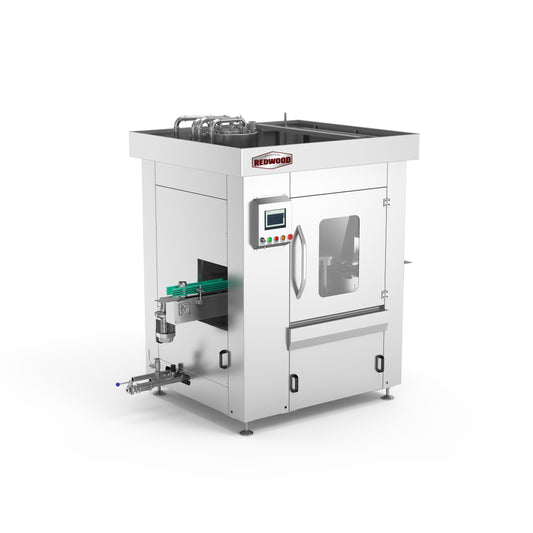
Collection: Commercial Beverage Canning Lines

Counter-pressure canning lines for breweries and beverage producers, from compact in-house packaging to high-speed production. Compare 5–600 CPM systems based on production volume, beverage type, labor, floor space, utilities, and growth plans.

Canning Systems

A counter pressure canning line is used to package carbonated beverages while maintaining pressure to reduce foaming and dissolved oxygen pickup during filling.

This collection is ideal for craft breweries, beverage startups, and growing producers seeking reliable beverage packaging solutions.

The collection includes compact startup canning systems, low-DO fillers, and larger production-scale canning lines designed for efficient beverage packaging workflows. These systems help maintain carbonation, improve fill consistency, reduce product loss, and support reliable packaging performance across different production volumes.

From pilot operations to commercial-scale facilities, Redwood canning systems support scalable packaging expansion, operational efficiency, and long-term production growth.

Planning Questions

How do I determine the right canning line capacity?

Start with your actual production plan rather than rated CPM alone. Consider packaging days, available run hours, batch size, SKU and can-format mix, changeovers, available labor, downstream packaging, and expected growth.

The goal is to select capacity that fits the complete operating workflow—not simply the highest available CPM.

Where are Redwood rotary canning lines manufactured, and what components are used?

Redwood rotary counter-pressure canning lines are manufactured and assembled in China, while many critical controls, instrumentation, motors, pneumatics, sensors, bearings, and lubrication components are specified from established international manufacturers.

Depending on the final configuration, these may include Siemens, SMC, SEW, Schneider Electric, Danfoss, SICK, IFM, Endress+Hauser, Tsubaki, SKF, and NSK.

Final component specifications are confirmed with the approved equipment configuration.

What commissioning and technical support is available in the U.S.?

For rotary filler/seamer projects, Redwood works with U.S.-based technical service resources experienced with rotary filling and packaging equipment.

Depending on the approved project scope, support can include commissioning, operator training, maintenance recommendations, troubleshooting, remote technical support, and coordination of onsite service when required.

What should I know about warranty, spare parts, and wear components?

Our current standard equipment warranty covers non-wear and non-consumable components for one year following installation and commissioning. Normal wear items and consumables are excluded.

Current equipment packages also include a first-year spare-parts kit intended to cover common wear and replacement items expected during approximately the first year of normal operation.

For larger or less frequently replaced components, recommended critical spares and expected lead times can be defined with the final equipment proposal.

What maintenance should I plan for?

Maintenance requirements depend on the final machine configuration, operating hours, production conditions, and sanitation practices.

Routine requirements may include inspections, lubrication, seamer roller maintenance, seals and gaskets, bearings, and other wear components. Appropriately trained customer maintenance personnel can perform many routine maintenance and common wear-component replacement tasks.

A recommended maintenance schedule can be developed around the actual equipment and operating conditions.

Can Redwood provide more than the filler and seamer?

Yes. Redwood can configure a complete packaging system around the rotary filler/seamer.

Depending on the project, this may include depalletizing, can handling and conveyance, accumulation, rinsing, nitrogen dosing, drying, inspection, coding or labeling, cartoning or shrink packaging, case handling, palletizing, stretch wrapping, and associated controls.

The final system should be developed around your production requirements, available space, can formats, product mix, and desired level of automation.

What information should I prepare before requesting a proposal?

A useful starting point includes your:

Can sizes • Product types • Production hours per shift • Number of shifts • SKU mix • Typical run length • Packaging format • Available floor space • Utilities • Desired automation level • Expected growth

With these assumptions, we can develop a more meaningful comparison of capacity, layout, utilities, equipment scope, and project requirements.

Not sure where to start?

Our team can help review your production requirements before equipment selection.

Request a Canning Line Review →